
Tuesday, May 13, 2014
Behind the Page... Nebe
Hero or villain? Arthur Nebe was commander of Einsatzgruppen B and responsible for mass executions during the Holocaust. He was also a member of the resistance and was executed by the Nazis for his involvement in the July 20 Plot.

Monday, May 12, 2014
Behind the Page... Stauffenberg
Claus Graf von Stauffenberg is probably the most well known of all of the July 20 conspirators since he was the one that set the bomb in the bunker that was supposed to kill Hitler. The bomb did detonate, but Hitler survived. Stauffenberg was executed by firing squad on July 20, 1944. The movie Valkyrie (Tom Cruise stars as Stauffenberg) is quite good and pretty much historically accurate.

Friday, May 9, 2014
Behind the Page... Olbricht
Friedrich Olbricht was a key member of the resistance because of his position in the Army High Command in Berlin. After the failed assassination attempt of July 20, 1944, he was executed.

Thursday, May 8, 2014
Behind the Page... Schlabrendorff
Fabian von Schlabrendorff served as Tresckow's adjutant on the eastern front in Army Group Center. He acted as a liaison between Tresckow and Oster to coordinate the resistance. Schlabrendorff's memoirs We Almost Killed Hitler provided the inspiration for Kurt's activities in the resistance during the last part of Slow Boil. Amazingly, Schlabrendorff survived imprisonment and torture.

Wednesday, May 7, 2014
Behind the Page... Gersdorff
Rudolf von Gersdorff attempted to assassinate Hitler by wearing a bomb during a museum tour with Hitler. The attempt failed, but Gersdorff was not discovered. Gersdorff survived the war and recorded his involvement in the resistance movement in his autobiography Soldier in the Downfall.

Tuesday, May 6, 2014
Behind the Page... Tresckow
Henning von Tresckow was the driving force behind the resistance to Hitler in the Wehrmacht. As Chief of Staff of Army Group Center on the eastern front, he, like Oster, surrounded himself with like-minded people. He played an instrumental role in several attempts on Hitler's life. When the July 20 Plot failed, he committed suicide rather than risk exposing others to Nazi reprisals.

Monday, May 5, 2014
Behind the Page... Beck
General Ludwig Beck was Chief of the General Staff for the Wehrmacht. He resigned in protest to Hitler's military policies despite Oster's advice to the contrary. He later became the ruling patriarch of the July 20 Conspirators. He was allowed to shoot himself rather than face death by firing squad on July 20, 1944.

Saturday, May 3, 2014
Behind the Page... Goerdeler
Carl Goerdeler was one of the most prominent civilians involved in resistance to the Nazi regime. He served as the mayor of Leipzig until removed from office for his outspoken anti-Nazi positions. While Goerdeler did break under Nazi interrogation, his long fight against Nazism should be how he is remembered. He was murdered by the Nazis.

Thursday, May 1, 2014
Behind the Page... Oster
General Hans Oster is my personal favorite among the July 20 Conspirators. Early on he saw the evil for what it was and fought it. As deputy of the Abwehr, the military intelligence branch of the Wehrmacht, he used his position to influence and attempt real change even plotting a coup as early as 1938. He filled the Abwehr with like-minded individuals such as Dohnanyi and Bonhoeffer. Oster was also murdered by the Nazis.

Wednesday, April 30, 2014
Behind the Page... Canaris
Admiral Wilhelm Canaris was Chief of the Abwehr, the military intelligence branch of the Wehrmacht, in Nazi Germany. Early on he disliked Hitler and Nazi policies but felt himself too old to effectively coordinate a coup. Instead, he empowered his deputy General Hans Oster to do just that. Canaris was murdered at Flossenburg concentration camp in April 1945.

Monday, April 28, 2014
Behind the Page... Gas Vans
Himmler became concerned about the brutalizing effect that shooting Jews and other victims of Nazi ideology had on the Einsatzgruppen soldiers. He ordered that a more efficient and distant form of killing be developed. The first attempt at this were the gas vans. The exhaust pipes were inserted into the back of the sealed van so that victims died of carbon monoxide poisoning.

Sunday, April 27, 2014
Behind the Page... Babi Yar
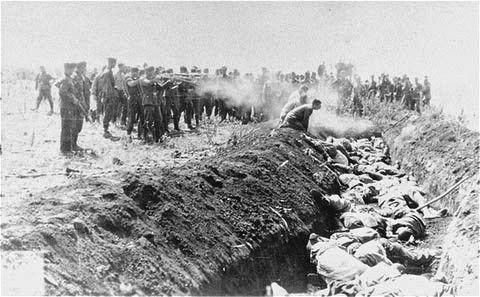
Not everyone died immediately. Often Einsatzgruppen soldiers would go into the pit and shoot survivors. This is the sort of scene that Kurt witnessed at Babi Yar.

Saturday, April 26, 2014
Behind the Page... More Einsatzgruppen
The Einsatzgruppen quickly became more organized in their approach to mass execution. Jews in Ukraine and Russia were shot on the edge of a pit so that their bodies would fall into the pit making burial more convenient.
Friday, April 25, 2014
Behind the Page... Einsatzgruppen
The special killing squad units of the SS who were the first perpetrators of the "Final Solution" on a large scale were called Einsatzgruppen.

Wednesday, April 23, 2014
Behind the Page... Deadly Snow
Far more German soldiers died from hypothermia than Soviet bullets during the winter of 1941-42.

Tuesday, April 22, 2014

Monday, April 21, 2014

Sunday, April 20, 2014

Saturday, April 19, 2014

Friday, April 18, 2014

Subscribe to:
Posts (Atom)